
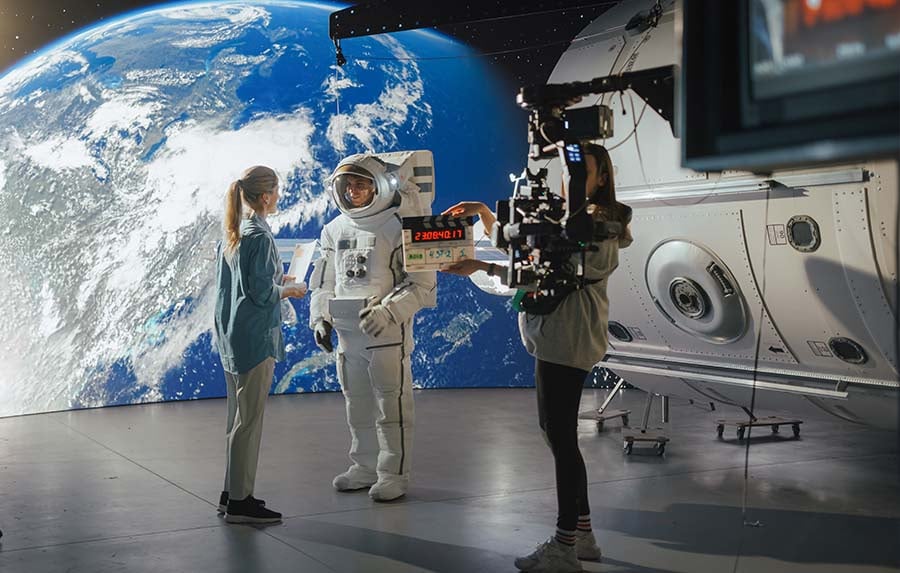
AI is revolutionizing the entertainment industry by personalizing user experiences and accelerating content creation. Streaming use recommendation algorithms to curate content tailored to individual tastes. In film and gaming, AI facilitates procedural content generation, enabling the creation of hyper-realistic visual effects and immersive virtual worlds. Beyond consumption, generative AI is transforming music composition and scriptwriting, while AI-driven tools streamline video editing and deepfake technology for digital de-aging. Ultimately, AI fosters a new era of interactive, data-driven entertainment, blending human creativity with powerful computational insights.
Streaming giants use advanced neural networks to curate hyper-personalized interfaces, predicting not just what you want to watch, but generating custom trailers and thumbnails designed specifically to appeal to your personal aesthetic.

Using high-fidelity voice synthesis and facial motion capture, studios create "digital humans." Celebrities are even trademarking their AI likenesses for use in authorized digital films and multilingual dubbing.
AI tools now automate tedious post-production tasks, such as removing unwanted objects from frames, upscaling old footage to higher resolution, and instantly syncing audio for global dubbing in hundreds of languages.

Game developers use AI to create vast, procedural worlds and "smart" Non-Player Characters (NPCs) that hold unique, unscripted conversations with players, making virtual environments feel truly alive.

Studios leverage AI to analyze social trends and "micro-decisions" in viewer behavior to predict the commercial success of a script or music track before it is even produced, significantly reducing financial risks.


Platforms allow creators to generate royalty-free, cinematic soundtracks by simply describing a mood or tempo, while AI mastering tools ensure studio-quality sound for independent artists at a fraction of the cost.